
Creating remarkable content is essential in a content marketing strategy, but if it’s not SEO optimized, it won’t help you stand out in search engines.
And while writing for humans first rather than search engines, it’s important to make sure people find your content so they can enjoy it.
Today, I will tell you about some tips to follow so that your content is seen and indexed by search engines.
Create quality content
There is no doubt that quality content is at the heart of your site’s success in search results. The SEO tips you will find here will help you, but without the content, they are useless.
But how does Google manage to determine whether content is of quality or not? There are at least 3 main methods:
Visitor behavior analysis: Behavioral tags established by Google are used to determine how a visitor interacted with content. Among these are the bounce rate (the percentage of visitors who go to a page and leave without interaction) and the time a visitor spends on a page. Google wants to see a low bounce rate and a higher page view time.
Checking SEO rules: Crucial factors for ranking well are the indexability and searchability of your content. Your site should be easily indexed by search engine robots and found by your target customers. However, Google expects you to follow SEO guidelines, which means you should follow “White Hat” methods and avoid “Black Hat” methods. It’s much easier to follow the rules than to get penalized.
Rating by real people: Rating all new content on the Internet isn’t realistic, but Google has proven to employ people to rate content with a very specific rating guide. So even if you manage to position yourself through questionable practices, you could still be manually penalized. In a nutshell, it’s easier to create content that your users will enjoy.
To create quality content, it is important to know the needs of your target audience. Then you have to find solutions to their problems.
Optimize your content
Even if your content puts you at the top of search results, optimizing your content for SEO can help you perform even better.
While there are several optimization methods, every piece of content should include the following:
- An attention grabbing title with a main keyword phrase.
- Subtitles including the main keyword phrase and several synonyms or keywords related to the main phrase.
- The main keyword phrase is found in the first paragraph.
- Titles and subtitles use H1, H2, H3 tags and so on.
There are a few tools for assessing the readability of a text in French. Word and Outlook have one included and you can use these online:
Translated Labs
Textalyser
The length of the content and its ease of reading also play a role. It is recommended that articles be at least 1000 words and have a readability score of around 60-70 points.
Optimizing your content is important because it will help you build long-term search engine value and reach your target audience faster.
Optimize meta tags
Meta tags are usually not visible when a reader views your article, but are essential for search engines.
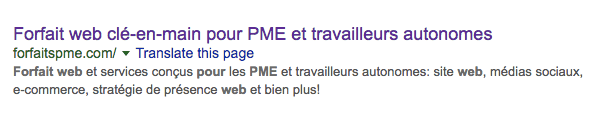
Meta description – this should be no longer than 160 characters and should be brief and to the point. Don’t forget to include your keyword phrase. If you don’t compose a meta description, Google will choose a random piece of text from your article or display your article without a meta description, which is even worse.
The “title” tag – this is the title that appears in blue (or purple if you have already visited the site) in the search results. It should be no longer than 70 characters and include your keyword phrase.
Add visual content
Quality articles are essential in digital marketing. Let’s be honest, we don’t spend hours polishing our content just to educate our readers. The goal is to attract, convert, and retain customers.
If your content is getting a lot of visits but few conversions, that’s an indicator of a major problem. While it’s possible that your content is of little value to your readers, chances are it’s because your content is too crammed and visually boring to keep readers engaged.
To figure out what’s wrong, you can use tools like CrazyEgg or LuckyOrange. Then you just need to analyze how users interact with your content. It should be fairly easy to determine why people are leaving your site. Maybe it’s too long paragraphs or lack of appealing subtitles.
We live in a world where visitors only browse content or have short attention spans. No one will take the time to read in detail and decipher your content. It’s your job to turn each article into an enjoyable, entertaining, yet valuable experience. Structuring your content effectively with visuals is essential.
What kind of visual elements? Good quality images, infographics, videos, animated GIFs, quotes and bullet points.
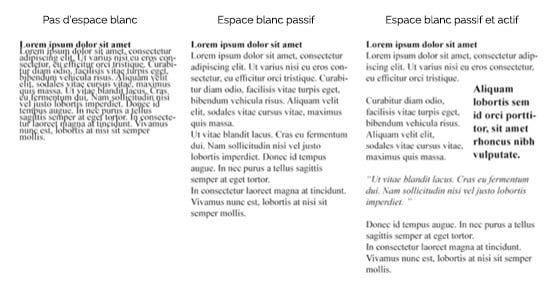
Make sure your page doesn’t look like a wall of text. Separate them into easy-to-absorb blocks with white space between each section. The image below is a good example.
When adding visual content, it is important to ensure the following:
The file name: it should include your keyphrase, separated by -.
The alt tag: the text in the alt tag is used to explain what your image represents. Once completed, it will be used to index your images in search engines in addition to clarifying their context.
Make it easy to share on social media
Social media is at the heart of digital marketing. Facebook, Twitter, LinkedIn, Google+, Pinterest, Instagram and other networks are the perfect platforms to promote yourself, foster brand loyalty and increase your credibility. It’s no surprise that companies invest time and resources to keep their followers engaged by posting new articles, sharing relevant content, running contests, and more.
Success on social media largely depends on how easily your content can be shared on social media. Although for marketing experts this is a simple task, your customers will not waste their precious time looking for which button to click to share it in their network.
Your content must therefore have elements of sharing prominently. This means that they should be placed at the top or bottom of the page, or follow the scrolling of the page to the right or to the left. Like this:

or

Place an attractive call to action
Incorporating a call to action into landing pages is common practice. But it’s also a good idea to put it in every blog post, infographic, or video you produce. Why? Because calls to action make your content actionable and push your site visitors one step further in the sales process.
The Hubspot blog demonstrates how effective this practice is. Each of their articles features offers for products or services, e-books or PDFs. Like this:

Clicking on this image takes you to a personalized landing page, where you can choose to fill out a form to take advantage of the offer.
At the SEO level, the calls to action are very good. They offer additional content to your visitors and increase the average time spent on your site. In short, a call to action is the most valuable internal link, which should be used to bring your potential customers to the right pages. These will bring them closer to converting into a customer. Dont miss this opportunity!
Conclusion
Site content and search engine optimization (SEO) go hand in hand. You could produce a ton of content, but if it’s not optimized, it will never be a worthwhile investment.
SEO is the step that makes your content easily exploitable for search engines and robots. With all these little SEO tweaks, your target audience will find your articles, podcasts, and videos more easily on Google. This is why you need to optimize your content before publishing it. It doesn’t take that long, but could earn you a lot.

Is your content SEO optimized?
Send me a page from your website and I will analyze it for you!
